The Land Bridge Next Door: How Mexico's Interoceanic Corridor could reroute trade through Tampa Bay and the I-4 corridor
Trade & Logistics · Port Tampa Bay
The Land Bridge Next Door
How Mexico's Interoceanic Corridor could reroute trade through Tampa Bay and the I-4 corridor
For two years, the world's supply chains were held hostage by a stretch of water barely 50 miles long. When drought dropped the Panama Canal's Gatún Lake to record lows, the canal authority slashed the number of daily crossings and the depth at which ships could sit in the water. Freight rates spiked, and vessels queued for days. The acute crisis has eased in 2026, but the canal isn't out of the woods: a strengthening El Niño has already pushed the Panama Canal Authority to announce fresh draft restrictions beginning July 24, tightening again in mid-August. The lesson for shippers has been blunt — leaning on a single chokepoint is a risk.
About 700 miles to the north, Port Tampa Bay is quietly positioning itself to benefit from the alternative that lesson created.
A land-based canal
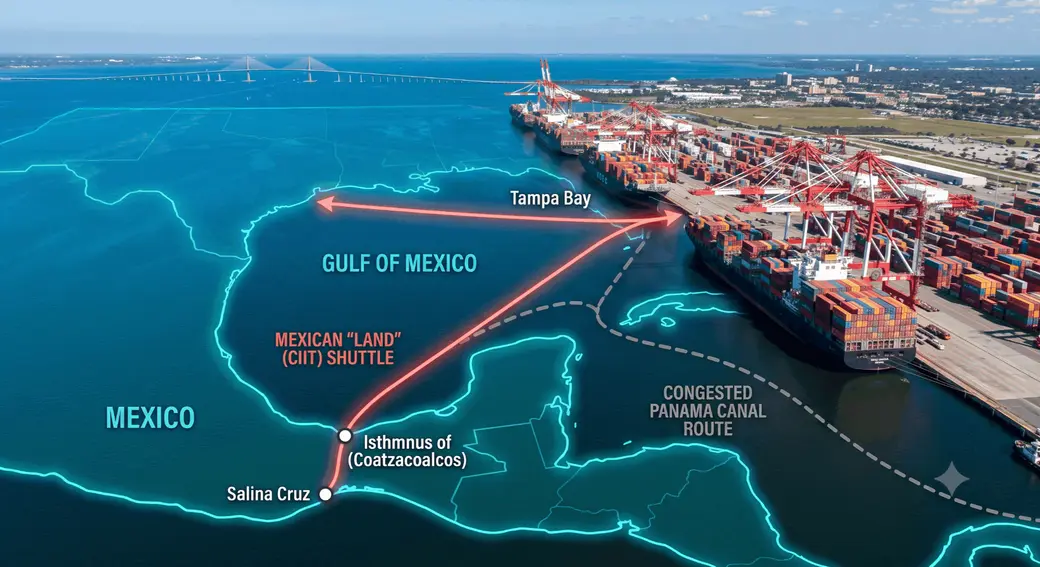
Mexico has rebuilt a rail corridor across the Isthmus of Tehuantepec — the country's narrowest point — connecting the Pacific port of Salina Cruz to the Gulf port of Coatzacoalcos. Officially the Interoceanic Corridor of the Isthmus of Tehuantepec (CIIT), it is already being called a "land-based Panama Canal." Rather than floating ships through locks, the CIIT lifts containers off a Pacific vessel onto a train, hauls them roughly 300 km across the isthmus in about nine hours, and reloads them onto a ship on the Gulf side.
The corridor's main freight line has been running since December 2023, with the broader system's build-out targeted for completion in 2026. Early movers have proven it works: in 2025, Hyundai's logistics arm moved 900 vehicles across the isthmus by rail in a pilot run. Volumes are still small — roughly 40,000 containers in 2024 against the Panama Canal's millions — but the trajectory is the story. And Mexico isn't just building a transit lane; along the tracks it is developing 14 "Development Poles for Well-Being" offering federal and state tax incentives to attract automotive, electronics, medical-device, and pharmaceutical manufacturing — exactly the high-value goods this route is built to carry.
Why Tampa, specifically
Here is the part that should interest anyone doing business along Florida's I-4 corridor: Coatzacoalcos sits almost directly across the Gulf from Tampa. By Mexico's own logistics figures, the sailing distance is just 1.8 days — closer than New York (4 days) and only marginally farther than Houston. That geography enables a short-sea shuttle that lands goods in Tampa without ever touching the Panama Canal or the congested ports of Southern California.
| Destination (from Coatzacoalcos) | Avg. sailing days | Note |
|---|---|---|
| Houston, TX | 1.3 days | Closest Gulf hub |
| New Orleans, LA | 1.5 days | — |
| Mobile, AL | 1.6 days | — |
| Tampa, FL | 1.8 days | Gateway to I-4 corridor |
| New York, NY | 4.0 days | More than 2× Tampa |
| Rotterdam / Hamburg | 15 days | Europe |
Average sailing days from Coatzacoalcos · Source: CIIT / Government of Mexico logistics platform
The timing is ideal for Tampa. Port Tampa Bay's container volumes have grown more than 300% since 2018, reaching roughly 263,000 TEUs in fiscal 2025, and the port is building toward one million containers a year. Six new post-Panamax cranes are due online by the end of 2026, and the shipping channel is slated for deepening. The port sits at the mouth of the Southeast's fastest-growing logistics corridor — Tampa to Orlando — home to more than 400 regional distribution centers feeding Florida's booming population.
Today, much of the Mexican and Asian freight bound for Florida arrives by truck, a long haul around the Gulf through Texas. Shifting even a portion of it onto a CIIT rail-and-Gulf-shuttle route trims fuel, labor, and highway congestion — and lands goods closer to the warehouses that need them.
|
The Gulf of Mexico spent a century as Tampa's front porch. Mexico's land bridge might finally make it a highway. |
The catch: double handling
The CIIT is not magic, and honest analysis has to name its central weakness. The Panama Canal is a single continuous water transit — one ship, ocean to ocean. The land bridge requires multimodal shifting: unload the Pacific ship, load the train, cross, unload the train, load the Gulf ship. Every one of those "touches" adds crane time, labor, and cost.
That math rules the CIIT out for cheap bulk commodities like grain and coal, where a few dollars per ton decides everything. But for high-value, time-sensitive cargo — auto parts, electronics, branded consumer goods — shaving days off transit is easily worth the extra handling fee. The corridor will win selectively, not universally.
A realistic timeline
|
Now – 2026
Pilot
Niche volumes, well under 1% of Panama's throughput. Early adopters test the lanes as ports finish upgrading.
|
2027 – 2029
Regional disruptor
Direct Gulf shuttles to Tampa turn routine, trimming several days off Asia-to-Florida transit.
|
2033 +
Global alternative
Target of 1.4M TEUs a year — a mid-teens share of Panama's flow. Enough to matter, not to replace.
|
Which points to the corridor's real strategic role. It will not kill the Panama Canal. What it can do is act as a price governor — a credible alternative that caps how aggressively Panama can raise transit fees, because shippers now have somewhere else to go.
The bottom line for Tampa Bay
For local business owners, supply chain managers, and economic development officials, the CIIT is not a 2026 revolution — it's a 2027-and-beyond opportunity worth positioning for now. Warehouse developers, logistics firms, and the port itself are already building the capacity a Gulf shuttle would require. The businesses that map their supply chains against this emerging route early will be the ones ready when the first regular Tampa–Coatzacoalcos service sails.
For Tampa Bay commercial real estate, the question is no longer whether the corridor matters — it is who positions for it first.
Sources & Data Notes
Transit days, port list, rail network and line details, the 14 Development Poles, and completion target — Government of Mexico / Proyectos México (CIIT) and the CIIT logistics-platform trifold. CIIT operational status, Hyundai Glovis pilot, ~40,000 TEU (2024), and the 1.4M-TEU / 2033 target — Container News, Automotive Logistics. Panama Canal drought recovery and July–August 2026 draft restrictions — Panama Canal Authority via Riviera. Port Tampa Bay volumes, cranes, Vision 2030 and I-4 figures — Maritime Executive, Business Observer.
Categories
Recent Posts